
AI and Marketing in Business: How Outsourcing Helps Business Owners
AI has changed the way businesses attract, serve, and keep customers. The challenge is that most business owners do not have spare hours to test software, write content, review data, fix campaigns, and train staff while still running the business.
That is where outsourcing becomes useful. AI can do a lot, but it still needs direction. Outsourced marketing support gives business owners access to people who know which tools to use, what to measure, and how to turn AI output into real business activity.
For many Australian businesses, the goal is not to replace people with machines. The goal is simpler: get better marketing done with less waste, less guesswork, and less pressure on the owner.

AI is useful, but it is not a marketing strategy
AI tools can write drafts, sort customer information, summarise reviews, suggest campaign ideas, analyse patterns, and speed up many daily tasks. That makes them valuable. It also makes them easy to misuse.
A business can generate 30 blog ideas in a minute. That does not mean those ideas are worth publishing. AI can draft an email campaign. That does not mean the message fits the customer, the offer, or the timing.
Marketing still needs human judgement. A strong strategy answers practical questions like:
Who is the best customer?
What problem does the business solve better than competitors?
Which channels actually bring enquiries or sales?
What message feels clear, honest, and relevant?
Which tasks should be automated, delegated, or stopped?
AI helps with speed. People help with meaning.
When business owners try to use AI without a plan, they often end up with more content but less clarity. The work looks busy, yet the results stay patchy. Outsourcing helps because an experienced marketing team can turn AI from a random tool into part of a reliable system.
AI is strongest when it handles repeatable tasks, supports research, or gives a faster first draft. It works well when a person reviews the output and checks it against the business goal.
Here are practical ways AI can support marketing in a business.
It can speed up content planning
Content still matters because customers research before they buy. They compare options, read reviews, check websites, and look for signs of trust.
AI can help build content plans around customer questions, seasonal patterns, and common pain points. For example, a plumbing business might need articles about leaking taps, blocked drains, hot water issues, and when to call a licenced plumber. A homewares retailer might need buying guides, care tips, and product comparison content.
AI can suggest topics, outlines, email themes, and short-form content ideas. An outsourced marketer can then choose what fits the brand, local market, and sales goals.
It can improve customer communication
Many businesses lose opportunities because replies are slow, unclear, or inconsistent. AI can help draft responses for enquiries, review replies, quote follow-ups, and customer service messages.
This does not mean sending robotic replies. It means using AI to create a clear starting point, then refining it so it sounds human and helpful.
For example, AI can help prepare:
Follow-up emails after a quote
Appointment reminders
Review response templates
Customer onboarding messages
Post-purchase care instructions
Frequently asked question responses
When outsourced support manages this process, the business gets consistent messages without the owner writing every line from scratch.
It can make reporting easier to understand
Marketing reports often overwhelm business owners. Too many charts, too many numbers, and not enough plain English.
AI can help summarise data from website traffic, email results, customer enquiries, and sales activity. It can spot patterns that deserve attention, such as pages with high traffic but low enquiries, or emails that get opens but few clicks.
A good outsourced team can translate those findings into clear decisions. They can explain what needs to change, what is working, and what should be tested next.
The value is not the report itself. The value is knowing what to do next.
It can help personalise marketing
Customers respond better when the message matches their needs. AI can help group customers based on behaviour, interests, purchase history, or enquiry type.
A simple example is an online store sending different emails to first-time buyers, repeat customers, and people who added items to a cart but did not buy. A service business might send different follow-ups to new leads, past clients, and referral partners.
This kind of personalisation does not need to feel invasive. It should feel useful. The message should help the customer make a decision, solve a problem, or take the next step.

Why business owners struggle to manage AI marketing alone
Most business owners do not avoid AI because they dislike technology. They avoid it because the process becomes confusing.
There are too many tools, too many promises, and too much advice. One platform says it can write everything. Another says it can manage leads. Another promises automated customer journeys. The result is decision fatigue.
The owner still has to ask:
Is this tool safe to use with customer information?
Will it connect with existing systems?
Who checks the quality of the output?
How much time will setup take?
What happens if the content is wrong?
How will success be measured?
AI can save time, but only after someone sets it up properly. Without that, it can create more work.
Common problems include:
Unclear prompts
AI output improves when the instruction is specific. Vague prompts create vague content.
Generic content
AI often produces content that sounds acceptable but says little. Customers notice when writing feels empty.
Brand mismatch
A family-owned trade business, a health clinic, and a premium retailer should not sound the same. AI needs guidance to match tone and customer expectations.
Poor quality control
AI can make confident mistakes. It can invent details, miss context, or suggest ideas that do not fit Australian rules, industry standards, or customer needs.
Tool overload
Many businesses pay for software they barely use. Outsourced support can help choose a smaller set of tools and use them properly.
How outsourcing makes AI marketing more practical
Outsourcing gives business owners access to marketing skills without hiring a full in-house team. That can be especially useful for small and medium-sized businesses that need professional support but cannot justify several new roles.
An outsourced marketing team may include strategists, copywriters, designers, automation specialists, SEO support, advertising specialists, and project managers. The business does not need all of them full time. It needs the right people at the right stage.
Outsourcing turns AI into a managed process
AI works best when it sits inside a clear workflow. That workflow might look like this:
Task | AI can help with | Outsourced support adds |
Customer research | Summarising reviews, enquiries, and common questions | Finding the real customer need and priority |
Content planning | Suggesting topics and outlines | Choosing what supports sales and trust |
Writing | Creating first drafts | Editing for accuracy, tone, and clarity |
Email marketing | Drafting sequences and subject lines | Building timing, offers, and customer journeys |
Reporting | Summarising performance data | Explaining what to change next |
This balance matters. AI reduces the blank page problem. Outsourced experts reduce the risk of poor decisions.
Outsourcing protects the owner’s time
Time is one of the main reasons to outsource. A business owner can spend hours learning one tool, then another, then another. After that, they still need to create the campaign, review it, publish it, and measure it.
Outsourced support takes much of that work off the owner’s plate. The owner still gives direction and approves key decisions, but they do not have to manage every task.
That means more time for sales, operations, service quality, staff, suppliers, and customers.
Outsourcing brings consistency
Marketing often fails because it happens in bursts. A business gets busy, so marketing stops. Sales slow down, so marketing starts again. This creates an uneven pipeline.
Outsourced support can keep the rhythm going. AI helps produce drafts and data faster. People keep the plan on track.
Consistency might include:
Publishing helpful website content each month
Sending regular email updates
Refreshing service pages
Reviewing search performance
Following up leads
Testing offers and messages
Updating customer resources
Small actions done consistently often beat large campaigns done once and forgotten.
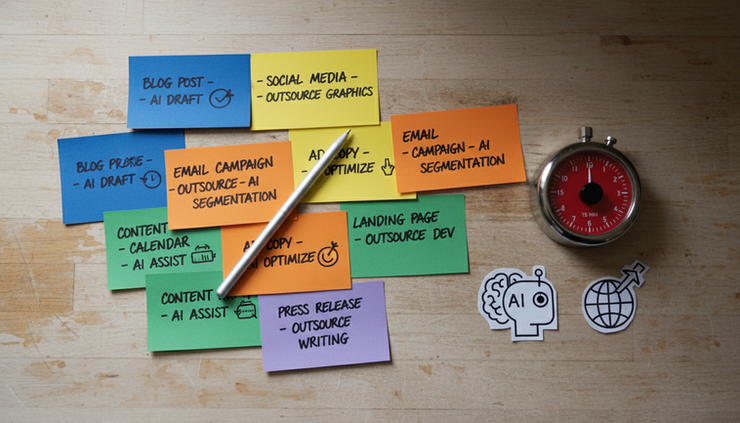
The best marketing tasks to outsource when using AI
Not every marketing task needs to be outsourced. Some work should stay close to the business owner, especially decisions about values, major offers, customer promises, and long-term direction.
The most useful tasks to outsource are the ones that need skill, consistency, or time.
Strategy and planning
AI can suggest options, but strategy needs human choice. Outsourced marketers can help set priorities, map customer journeys, choose channels, and build a plan that matches the business budget.
The plan should be simple enough to use. A 40-page strategy document that sits unread will not help. A clear monthly plan with owners, deadlines, and targets is more useful.
Website and search content
Customers often visit a website before making contact. If the site is unclear, slow to update, or thin on detail, the business may lose enquiries.
Outsourced support can use AI to help research topics and draft content, then refine pages so they answer real customer questions. This can include service pages, location pages, product guides, articles, FAQs, and case studies.
Good content should be accurate, useful, and easy to act on. It should explain what the business does, who it helps, and why the customer should trust it.
Email and customer follow-up
Email remains useful because it reaches people who already know the business. AI can help draft emails and segment audiences. Outsourced support can build campaigns that suit the customer journey.
This may include welcome emails, quote follow-ups, reactivation campaigns, seasonal reminders, referral requests, and post-purchase education.
The aim is not to flood inboxes. The aim is to stay helpful and relevant.
Marketing automation
Automation can save time when it handles repeat tasks. It can also annoy customers if it is poorly planned.
Outsourced specialists can design simple automations, test them, and check that they work. This might include sending a reminder after an enquiry, notifying staff when a form is submitted, or sending care instructions after a purchase.
AI can help write the messages. People should decide when, why, and how those messages are sent.
Performance reviews
Business owners need clear feedback. What worked? What failed? What should change?
Outsourced teams can review results regularly and explain them in plain English. AI can support the analysis, but a person should connect the numbers to business reality.
A useful review should answer:
Which activity brought enquiries or sales?
Which content helped customers take action?
Which campaigns should stop?
Which areas need more testing?
What is the next best use of the budget?
What a good outsourcing partner should provide
The right partner should make marketing feel clearer, not more complicated. They should be comfortable using AI, but they should not hide behind it.
Look for a partner that offers:
Clear communication
They explain what they are doing and why it matters.
Human review
They do not publish AI output without checking it.
Practical planning
They focus on tasks that support revenue, trust, and customer experience.
Respect for data
They handle customer information carefully and use tools responsibly.
Transparent reporting
They show results in plain language and connect them to business goals.
Flexible support
They can scale work up or down as the business changes.
Outsourcing should feel like having a capable marketing team beside the business, not another supplier creating more admin.
How to start using AI and outsourcing without overcomplicating it
A sensible start is better than a large, messy rollout. Business owners do not need to automate everything at once.
Start with one clear goal. For example:
Get more qualified enquiries
Improve follow-up after quotes
Publish better website content
Reconnect with past customers
Understand which marketing activity is working
Reduce repetitive writing tasks
Next, choose one or two areas where AI and outsourcing can help quickly. A service business might begin with enquiry follow-up and website content. A retailer might begin with email segmentation and product guides. A consultancy might begin with thought leadership content and lead nurturing.
Set simple measures before the work starts. These could include enquiry volume, conversion rate, repeat purchases, website form submissions, booked calls, or email replies.
Then review progress each month. Keep what works. Fix what does not. Avoid chasing every new tool.
The best systems usually grow from steady, practical improvements.
FAQ
Can AI replace a marketing team?
No. AI can speed up tasks, but it does not replace strategy, customer understanding, quality control, or creative judgement. It works best when skilled people guide and review it.
Is outsourcing cheaper than hiring marketing staff?
It can be more cost-effective for many small and medium-sized businesses because they can access different skills without hiring full-time staff for every role. The right choice depends on workload, budget, and long-term needs.
What marketing tasks should stay with the business owner?
The owner should stay involved in direction, customer promises, pricing decisions, major offers, and final approval for important messages. Outsourced support can manage the process, but the business voice still matters.
Is AI safe to use with customer data?
AI can be used safely when the right tools, settings, and policies are in place. Businesses should avoid putting sensitive customer information into tools without understanding how that data is stored or used.
How quickly can outsourced AI marketing show results?
Some improvements, such as faster follow-up or clearer content, can happen quickly. Bigger results, such as stronger search visibility or better customer retention, usually build over time with consistent work.

The takeaway for business owners
AI is already part of modern marketing, but it does not remove the need for clear thinking. It makes good marketing faster and poor marketing louder.
Outsourcing helps business owners use AI in a practical way. It brings skill, structure, consistency, and human judgement to the process. That means fewer random tools, fewer rushed campaigns, and less pressure on the owner to do everything alone.
A good place to start is simple: choose one marketing problem that keeps costing time or sales, then build a better system around it. With the right outsourced support, AI becomes less of a distraction and more of a useful part of everyday business growth.


Comments